
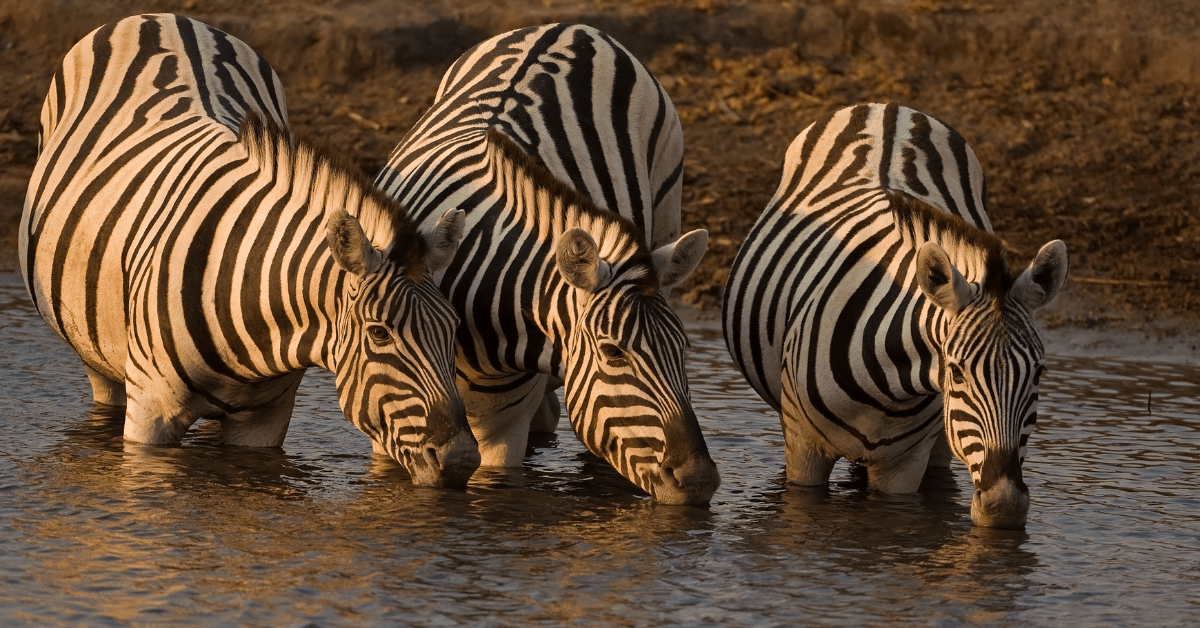
Zebras: The African savannah is a theater of extreme evolutionary adaptations, but few animals command the eye quite like the wild equine. Standing out against the muted golds and greens of the lowveld, the intricate zebra stripe pattern purpose seems like a glaring design flaw in a landscape dominated by stealthy predators. Yet, these patterns are anything but an accident. The zebra is a highly resilient, beautifully engineered animal that uses its coat as a high-tech tool to navigate everything from extreme temperature spikes to the lethal attention of lion prides.
The Physics of the Stripe: Survival or Illusion?
When driving through Kruger National Park, you will specifically encounter the Burchell’s zebra subspecies. These magnificent animals are easily distinguished by their shadow stripes, which are lighter, brownish lines running between the main black and white markings, often fading out completely down their legs.
| The Equine Striped Lineup | |
|---|---|
| Plains Zebra | The most abundant species. Features broad vertical stripes that wrap entirely around the underbelly. |
| Burchell's Zebra | The iconic Kruger subspecies. Noted for distinct brown shadow stripes and markings that fade on the lower legs. |
| Mountain Zebra | Inhabits rocky, high-altitude slopes. Identified by narrow body stripes, a gridiron pattern on the rump, and a throat dewlap. |
| Grevy's Zebra | The largest and most endangered species. Noted for its tall stature, massive rounded ears, and ultra-fine pinstripes. |
Decoding the Zebra Stripe Pattern Purpose
For decades, biologists argued over the true evolution of these African equines. The answers turning up in modern research reveal that the zebra stripe pattern purpose functions as a multi-layered defense mechanism rather than basic background camouflage.
One primary benefit of the pattern is motion dazzle. When a herd of Burchell’s zebras panics and runs from an attacking predator, the overlapping, shifting lines make it incredibly difficult for a hunting big cat to lock onto a single individual. The lines blur together, distorting the predator’s depth perception and calculation of speed during a high-speed chase.
Furthermore, the alternating bands create a personal cooling network. Because black fur absorbs heat and white fur reflects it, micro-currents of air spin right across the surface of the skin, lowering the animal’s body temperature as it grazes in the midday sun. Newer studies also show that this pattern confuses the compound eyes of biting tsetse and horseflies, preventing them from making clean landings and spreading blood-borne diseases through the herd.
Inside the Herd: Complex Social Alliances
Zebras are intensely social equines, relying on a system of family groups called harems. A typical harem consists of a single dominant stallion, several breeding mares, and their young offspring. The social structure is highly cooperative. While the stallion protects the rear during movements, a senior matriarch leads the group to known water sources and feeding grounds. Each individual recognizes its family members using a combination of distinct vocal barks, scent profiles, and their unique markings, which function exactly like a visual barcode.
This family bond becomes a literal shield when predators approach the herd. If a lion pride or a pack of spotted hyenas targets a young foal, the adult mares pull into a tight defensive cluster. They position their heads toward the center of the circle to protect their vulnerable faces, leaving their hindquarters facing out. Any predator bold enough to approach faces a barrage of explosive, bone-shattering kicks from their hind legs. A single well-placed kick from a Burchell’s zebra is powerful enough to shatter a lion’s jaw, rendering the predator unable to hunt.


Processing the Veld: The Ultimate Foraging Strategy
As herbivores, these animals are built to consume immense quantities of grass. They occupy a very specific niche in the African ecosystem known as bulk grazers. Because they possess a specialized digestive system called hindgut fermentation, they can process coarse, fibrous, low-protein vegetation that other ruminants like wildebeest or impala cannot tolerate.
This unique anatomy makes them the advance guard of the great seasonal migrations. Zebras move into tall, overgrown grasslands first, chewing down the tough upper canopy of the grass. This behavior opens up the lower, tender green shoots for the selective feeders moving along behind them, maintaining the health and balance of the entire grazing ecosystem.
Modern Threats to the Frontiers
Despite the brilliant evolutionary design of the zebra stripe pattern purpose, wild herds are facing sharp pressure across the continent. While the common plains variants remain stable in major national parks like Kruger, specialized species like the mountain zebra and the imperial Grevy’s zebra are fighting for space.
The greatest challenges are habitat fragmentation and the loss of historical migration paths. As livestock fences block access to permanent rivers during dry cycles, herds are cut off from vital survival grounds. Illegal hunting for their highly prized skins and competition with domestic cattle for water holes continue to impact vulnerable populations outside protected areas.
Preserving the future of these magnificent equines requires proactive, community-centric conservation models. International teams are actively working with local populations to establish open wildlife corridors and mitigate human-wildlife friction. By implementing sustainable land management strategies, we can ensure that these ancient family structures continue to move safely across the plains.
The zebra is far more than a beautiful design icon on a safari drive. They are the driving engines of the grassland systems, clearing the paths and setting the rhythm of survival for countless other species. Protecting them means protecting the raw, synchronized pulse of the African wild itself.
-
Read the scientific breakdown of motion dazzle and fly prevention on the International Union for Conservation of Nature (IUCN) official database.
-
Explore the subspecies mapping and census counts of Burchell’s zebra via the African Wildlife Foundation (AWF) wildlife guide.
Savannah Motion: The Dazzle Effect Simulator
Step into the herd. Can you use monochrome camouflage and group physics to confuse predators?
The Power of the Stripe
A single zebra standing alone is highly visible. But together, a herd creates a swirling optical illusion known as "dazzle camouflage" that distorts a predator's depth perception. Can you manage your herd mechanics to survive the plains?