Lilac-breasted Roller
✓ Reviewed by Nhongo Safaris Field Guide - Gift · Updated 4 November 2026
Lilac-breasted Roller at a glance
- LengthAbout 36 cm, plus tail streamers
- Wingspan50–58 cm
- WeightAbout 90–120 g
- DietInsects, scorpions, small lizards and snails
- HabitatOpen woodland and savanna
- NestingHoles in trees, usually 2–4 eggs
- ActiveBy day, hunting from a perch
- Conservation statusLeast Concern (IUCN Red List)
Track and paw print

Tiny and rarely seen. Lilac-breasted rollers have syndactyl feet, meaning their second and third toes are partially fused together.
Lesser-known facts
The roller is named for its courtship display. The male dives and tumbles through the air, rolling from side to side while calling loudly, to impress a mate.
Rollers hunt from a lookout perch, such as a dead branch or a power line. They watch for movement, drop onto prey on the ground, and fly back to beat larger prey against the branch before swallowing it.
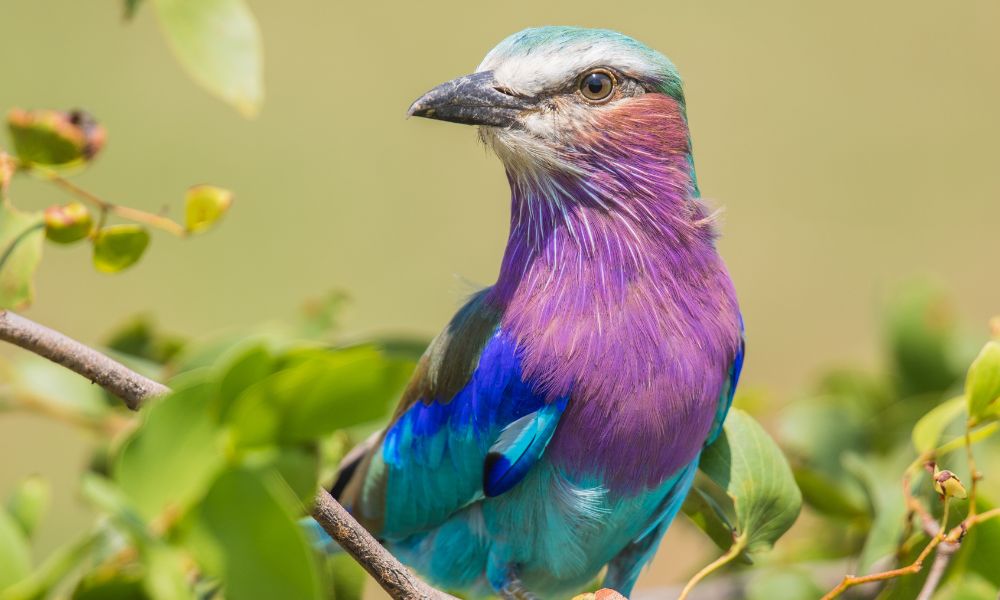
Its colours are hard to miss, with a lilac breast, turquoise belly, blue wings and green head. It is so loved that it is the national bird of both Botswana and Kenya.
Where to spot it in Kruger
Scan dead branches, fence posts and power lines beside the road, especially in open woodland and savanna. They stay all year, and the morning light shows their colours best.
Rollers often gather at fresh veld fires and beside grazing animals, where insects fly up. Look for a flash of blue on the highest open perch.
Photo gallery


Questions and answers
Why is it called a roller?
The name comes from the male's courtship display. He dives and tumbles through the air, rolling from side to side while calling loudly, to impress a mate.
Where is the best place to see lilac-breasted rollers in Kruger?
Scan dead branches, fence posts and power lines beside the road, especially in open woodland and savanna. Rollers choose a high, open perch to watch for insects, so they are easy to spot from a vehicle.
What do lilac-breasted rollers eat?
Mostly insects such as grasshoppers and beetles, plus scorpions, small lizards and snails. A roller drops from its perch to catch prey on the ground, then returns to beat larger prey against a branch before swallowing it.
Which countries have the lilac-breasted roller as their national bird?
Botswana and Kenya. It is loved across Africa for its colours, which include a lilac breast, a turquoise belly, blue wings and a green head.
Do lilac-breasted rollers migrate?
Not really. They stay in the same area all year and only move short distances. The European roller, a similar bird without the long tail streamers, visits Kruger in summer.
Best time to see the Lilac-breasted Roller
- Jan
- Feb
- Mar
- Apr
- May
- Jun
- Jul
- Aug
- Sep
- Oct
- Nov
- Dec
Best months: Sep–Dec
Rollers live in Kruger all year round, so you can see them in any month. From spring into early summer the males perform their rolling courtship dives, which is when they are most active and easiest to watch.
About the Lilac-breasted Roller
The lilac-breasted roller is one of the most colourful birds in the Kruger National Park, with a lilac breast, a turquoise belly, bright blue wings and a green head. It is so loved that it is the national bird of both Botswana and Kenya, and it is a favourite of photographers on safari.
Rollers hunt from a lookout perch such as a dead branch or a power line. They watch for movement, then drop onto insects, scorpions, small lizards and snails on the ground and fly back to beat larger prey against the branch. The name comes from the male’s courtship display, in which he dives and tumbles through the air, rolling from side to side while calling loudly.
Rollers are easy to find because they sit out in the open and stay in the park all year. On a guided drive, your field guide knows the open perches along the roads where rollers wait, and can stop so you can see the colours in the light.
See the Lilac-breasted Roller for real
Join one of our guided Kruger safaris and let our field guides find it for you.
Explore Kruger safari packagesRead the full story →Meet the Lilac-breasted Roller in our 3D Wildlife World
Explore our interactive map of the Kruger National Park, with the animals and the safari jeep.